/ optical engineer
Luis Mancio
Holographic reconstruction from a kinoform created with the Gerchberg–Saxton algorithm, designed to produce two different images at separate depths. It illustrates how phase-only holograms can control the focus of information in 3D space.
The reconstruction of a DOE is presented both numerically through simulation and experimentally by displaying the DOE on a Spatial Light Modulator (SLM), a device that dynamically modulates the phase of light to reproduce holograms.
Bessel beams are optical fields known for their unique properties, such as self-healing and extended depth of focus. While they are usually studied for integer and fractional orders, this project explores Bessel beams with complex-valued orders, investigating new behaviors.
Holographic interferometry is a technique that allows precise measurement of displacements and strains by visualizing interference fringes. This video illustrates how the visibility or contrast of the fringes changes with depth and depends on factors such as the system's numerical aperture and the coherence of the light source.
In this setup, we employ a laser to generate a highly sensitive interference pattern. By using a high-speed detector and a camera, we are able to measure acoustic and vibrational effects in different objects. The detector can be connected to a computer and functions like a microphone, allowing real-time analysis of the acoustic signal. Meanwhile, the camera provides access to the spatial distribution of the vibrations, offering a detailed visualization of how sound and mechanical disturbances propagate across the object.
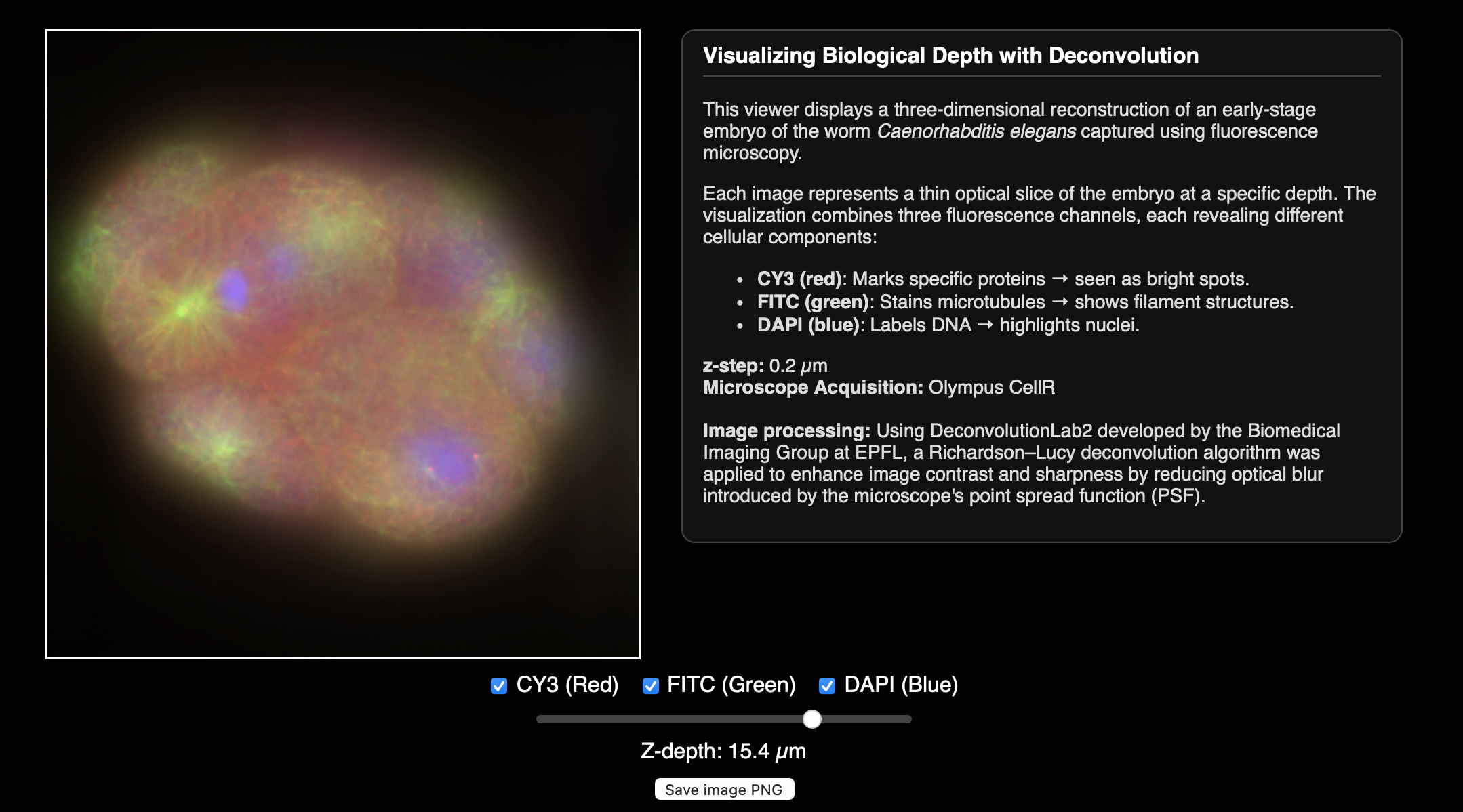
Visualizador de Microscopía

Visualizador de Microscopía

Haz clic para abrir el visualizador en una nueva ventana

▶️
Imagen grande
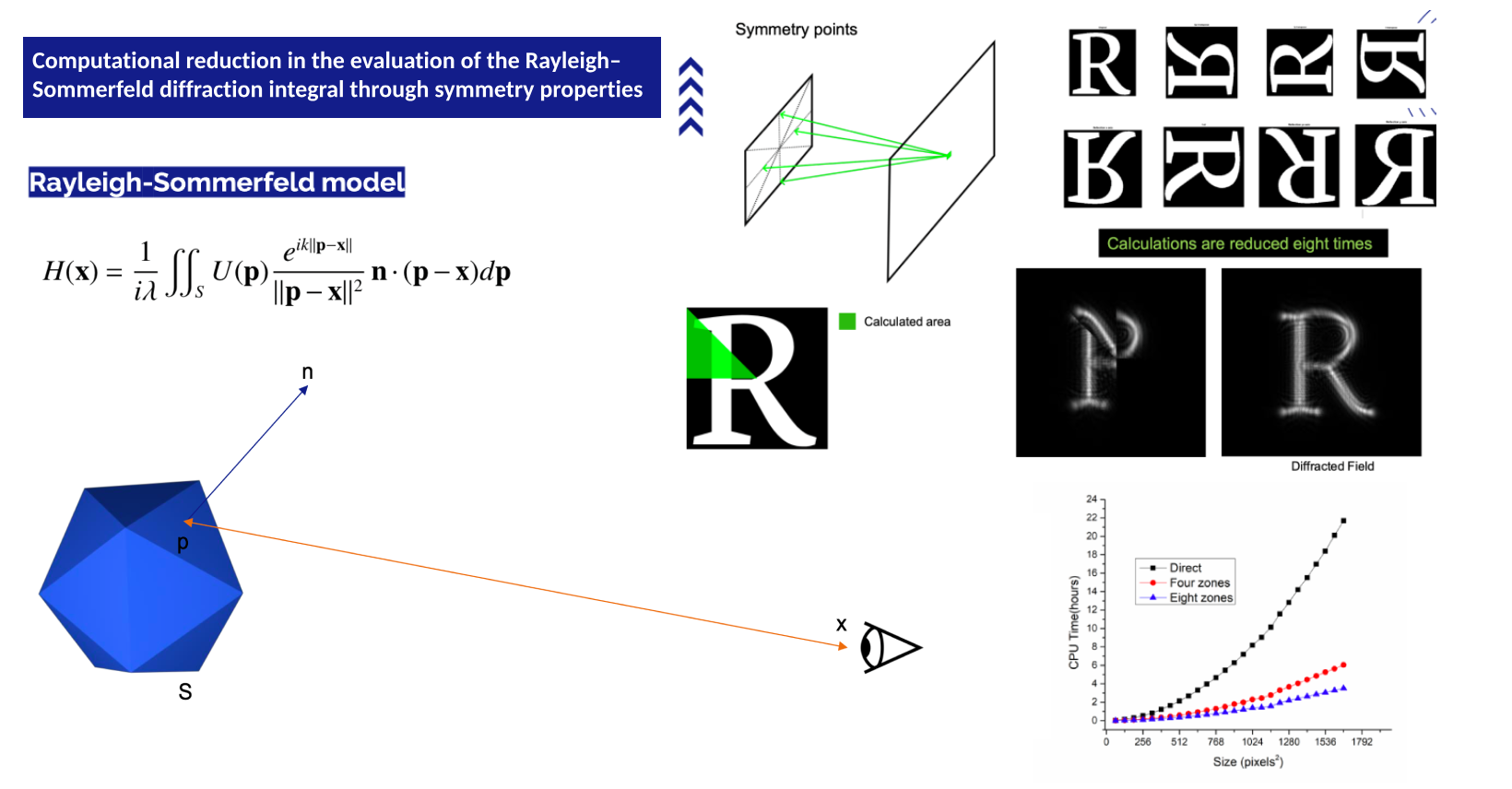
There are different approaches to compute the diffracted field of an object numerically, such as the Fresnel approximation. However, when aiming to calculate the exact integral in the near field, the computational time increases significantly. In this work, we present an analysis of how this computation can be reduced by exploiting the symmetries that arise in the problem. This strategy avoids recalculating redundant distances and instead relies on simple image rotations. The study is published in: Villa-Hernández, J. M., Olivares-Pérez, A., Herran-Cuspinera, R., Juárez-Pérez, J. L., Mancio, L., & Delesma, R. (2024). Study of Behavior of Geometric Symmetries of 3D Objects with Digital Fresnel–Kirchhoff Holograms, Using Non-Redundant Calculations. Symmetry, 16(9).

Imagen ampliada